


Midlife is a superpower – stop chasing after youth
Updated: Jan 28
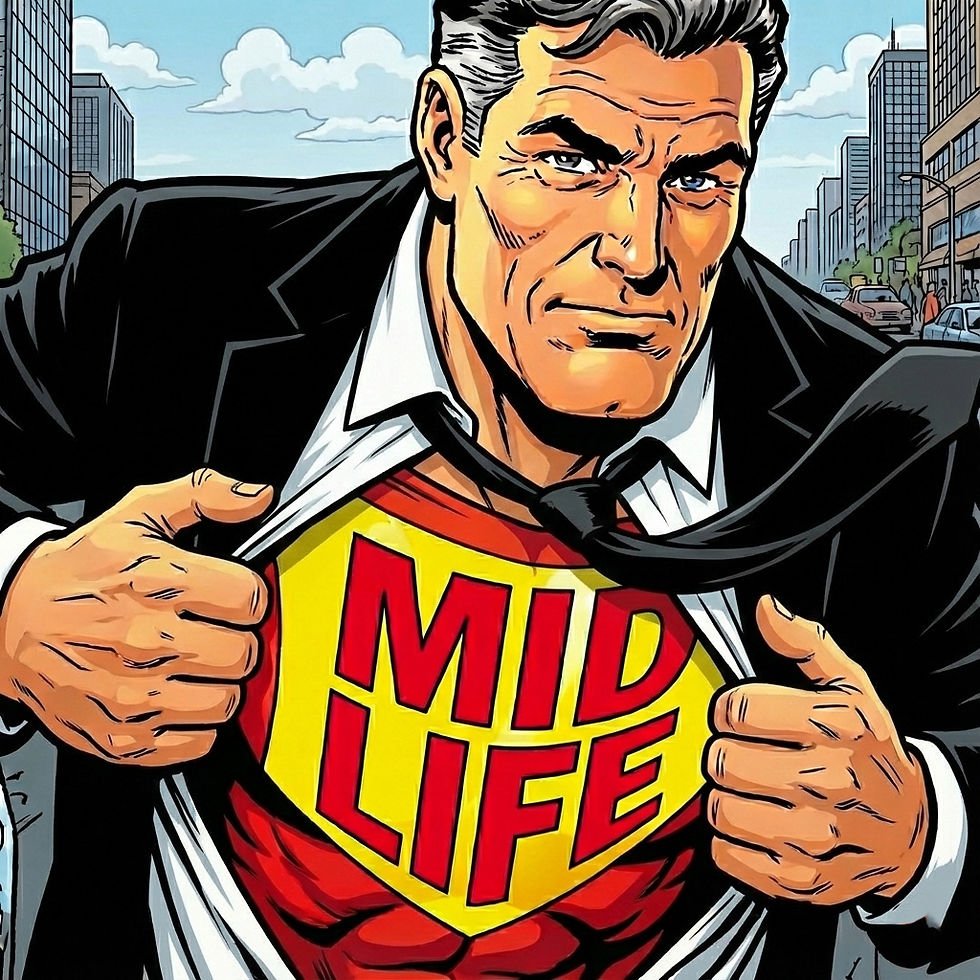
There’s a point in life where you stop trying to “keep up” with younger people and realize something important: you don’t have to. You’re playing a different game now – and if you use it properly, you’re holding better cards.
In your twenties, it's all about FOMO. Every project looks exciting, every invite feels urgent, every opportunity is “can’t miss.” You burn a ton of fuel. Some of it moves you forward, and a lot of it goes up in smoke.
By midlife, something shifts. You’ve seen enough patterns, made enough mistakes, and wasted enough time to know better. Which doesn’t mean you’re slower – you’re now more selective. Less flailing, more precision.
I hit a turning point a few years ago when I finally understood the value of my experience – and stopped competing on price. A content mill once asked if I’d “audition” for some work. I told them my writing samples are already online, and I don’t write for free.
Then came the punchline: a rate so low it barely covered coffee. “It’s volume work,” he added. “You can make real money if you write fast.” I laughed. “What you want is 30-minute filler – and I’m not in that business. If you’re shopping for the cheapest words, I’m not your guy.”
I wouldn’t even refer him to other writers, as I have too much respect for my colleagues.
Experience More Effective Than Raw Energy
Look at how we talk about performance:
“Hungry young talent.”
“High-energy rising stars.”
“Fresh blood.”
Energy is easy to spot. It’s loud, it moves fast, and it posts a lot. I’ve seen Gen Z-ers at media events, their thumbs moving in a blur as they post content to an audience that breathlessly awaits their every word. Problem is, this content is a reflection of your company, and quality does not happen at light speed. It requires thought, and some degree of reflection.
Unless someone’s bleeding out, nothing needs to be posted in real time. I prefer to sit down, grab a coffee, and edit properly – clean images, sharp phrasing, and a message that actually reflects the brand. Speed creates noise. Thought creates impact, and impact wins every time.
Consider Tom Brady. He won four of his seven Super Bowls after turning 37, and his final ring came at age 43 with Tampa Bay. Not because he was the most athletic quarterback on the field – he absolutely wasn’t – but because he read defenses faster, made better decisions, and conserved energy for the plays that mattered. Experience extended his peak long after his physical prime had passed.
Experience doesn’t just add years. It adds accuracy. You stop wasting time on the wrong battles, wrong people, and wrong metrics. The younger you chases everything; the current you picks your shots.
Your Brain is a Good Example
As you gain experience, your brain is quietly optimizing itself – it's a process called "pruning." It cuts the mental clutter and unnecessary connections, leaving only the fast, focused pathways for strategy, high-value problem-solving, and efficient execution. This is why you become so much more effective over time: you stop seeing every detail and start seeing only what truly matters.
Consider how chess grandmasters see the board. Beginners fixate on every pawn and every square because everything feels important. A grandmaster looks once and immediately spots the only two or three things that matter. Years of pattern recognition have pruned away the noise, leaving only the fast, efficient pathways for strategy and execution.
Experience vs. Energy in the Real World
Let’s be honest: pure energy has its place. Startups, early-stage careers, high-volume output – these often run on the fuel of youth. But when you look at who shapes the long game, experience shows up again and again.
Jeff Bezos was in his thirties when he started Amazon, but Amazon’s most sophisticated shifts – like turning the company into a cloud and infrastructure powerhouse with AWS – came later, guided by hard lessons from the dot-com crash, logistics failures, and strategic missteps. That wasn’t youthful chaos. That was experienced risk-taking.
Satya Nadella took over Microsoft in his late 40s. He didn’t bring wild energy; he brought perspective. Under his leadership, Microsoft shifted from defensive, Windows-centric thinking to a cloud-first, partnership-oriented strategy. The result – a massive cultural reboot and one of the most valuable companies on the planet. That’s midlife advantage at corporate scale.
These people aren’t winning because they can pull all-nighters. They’re winning because they know where to direct their effort – and where to stop.
The Midlife BS Detector
One of the most underrated advantages of experience is your built-in nonsense filter.
You’ve seen promises that went nowhere. You’ve watched people talk big and deliver small. You’ve tried the shortcuts and paid for them. Over time, your tolerance for fluff drops to near zero. Which gives you three serious edges:
You spot red flags faster.
You say ‘no’ sooner.
You stay in the game longer because you avoid more landmines.
The younger you might have been impressed by charisma. Current you watches for consistency. The younger you got hooked by urgency, while the current you asks, “Is this actually important?” Remember: urgency shouts; importance matters. Knowing the difference changes everything.
That shift alone can add years of productive, meaningful work and training to your life – simply because you’re not bleeding energy into pointless battles.
No Apologies for Being Older
If you’re in midlife and still hungry, you are not at a disadvantage. You just can’t play the same game you played at 25. And you shouldn’t. Here’s how to lean into your edge:
Aim narrower. Stop trying to be good at everything. Choose the areas where your experience matters most, and double down.
Protect your recovery. You know what happens when you ignore sleep, nutrition, fitness, or downtime. Use that knowledge. Recovery is a performance skill.
Teach, don’t preach. The best way to cement your experience is to share it – with peers, younger colleagues, clients, or your own audience. Teaching forces clarity.
Stay coachable. Experience can turn into arrogance if you let it. Keep one part of your mind permanently set to “student.” Satya Nadella once said, “Don’t be a know-it-all; be a learn-it-all.”
You Haven’t Peaked – You’ve Upgraded
Our culture loves to pretend that everything great happens before 30, and the rest is maintenance – and if you’re lucky, you may slow your inevitable decline. That’s crap. Midlife, used well, can be an upgrade cycle:
Less wasted motion.
Cleaner decisions.
Better boundaries.
Deeper work.
You don’t need to outrun younger people. You just need to out-think, out-focus, and out-last them. Experience gives you that ability – if you stop seeing it as baggage and start using it as leverage.
You haven’t peaked. You’ve just become more precise, and consequently, more effective. And in the long game, precision beats raw power every time.
Every message has two jobs: get noticed and get remembered. That’s where I come in – helping businesses turn everyday communication into something clear, compelling, and built to last. If you’re ready to sharpen your story, let’s talk.
Neil Moore is a communications specialist, freelance journalist, masters athlete, and family man who believes that excellence has no expiry date.
Statements made on this website have not been evaluated by any regulatory agency or body. The information and opinions provided by this website is information obtained by and the opinion of Neil Moore and in the case of health and wellness subjects is not a substitute for the direct, individual medical treatment or advice provided to you by a healthcare provider. As well, the products or procedures mentioned on this website are not intended to diagnose, treat, cure, or prevent any disease. It is the responsibility of you and your healthcare providers to make all decisions regarding your health.
NeilMoore.ca recommends that any decision with respect to your health and wellness or the diagnosis and treatment of any disease or condition is a decision made in consultation with your healthcare provider. Please also review the Terms and Conditions of NeilMoore.ca with respect to this website not providing professional or specialist advice.


Comments